Synthetic molecules
How the laboratory reinvented perfumery
Fisfis Academy · 14 min read ·
What you will learn
- Put the milestones of synthetic perfumery, from coumarin to Ambroxan, in order
- Explain the difference between molecules also found in nature, semi-synthetics and molecules with no counterpart in nature
- Understand the three generations of musks and why they changed
- Know what the headspace technique is used for
- Sort out common misconceptions about synthetics
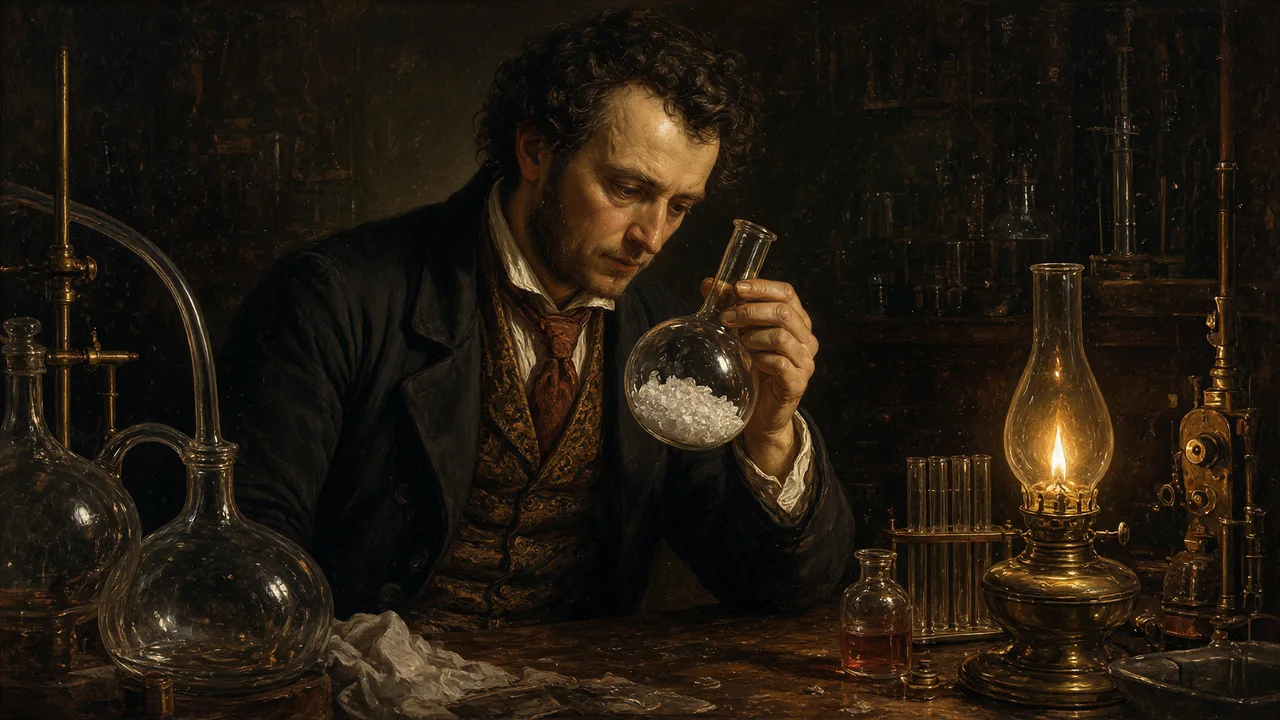
In perfumery, a synthetic is an aroma molecule produced in the laboratory whose chemical structure is fully known. Unlike the hundreds of components in a natural oil, a synthetic material consists of a single molecule or a few closely related isomers. That is why it smells the same in every batch.
It helps to divide synthetics into three groups. Those also found in nature (vanillin, coumarin, linalool) are lab-made versions of a molecule that already exists in a plant. Semi-synthetics are produced by chemically transforming a natural starting material, as Ambroxan is made from sclareol, which comes from a sage-type plant. Those with no known counterpart in nature (Iso E Super, Galaxolide) are entirely new smells.
Milestones
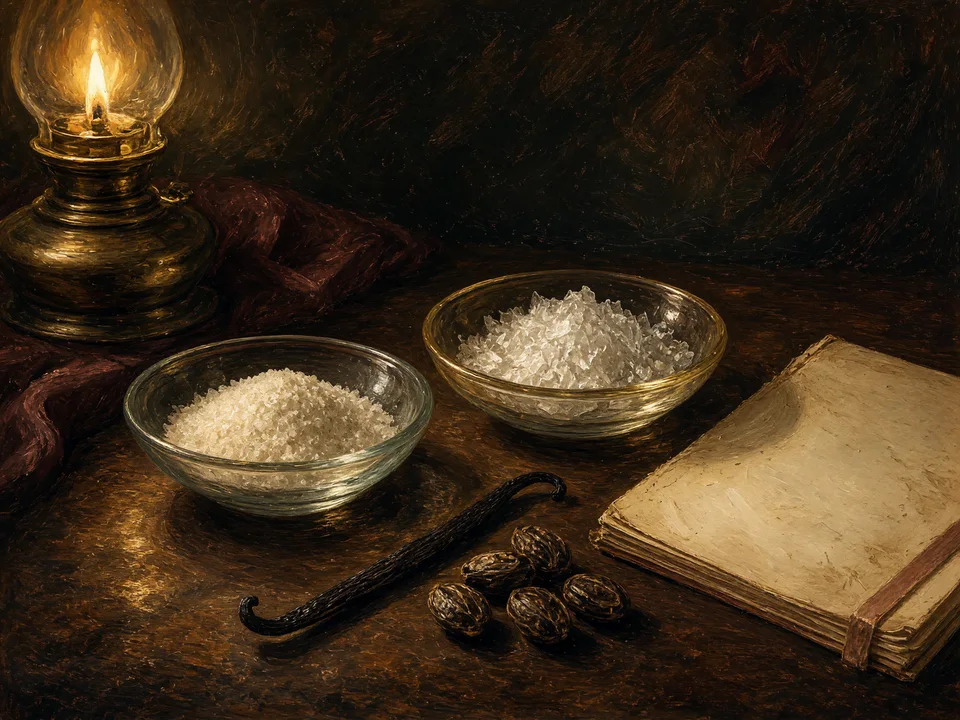
- 1868 – Coumarin: William Henry Perkin synthesizes coumarin. Found in the tonka bean, this molecule smells of hay and almond; in 1882 Houbigant's Fougère Royale uses it to launch the “fougère” family.
- 1874 – Vanillin: Ferdinand Tiemann and Wilhelm Haarmann produce vanilla's main odor molecule from coniferin, obtained from pine trees. In 1889 Guerlain's Jicky makes bold use of coumarin and vanillin.
- 1888 – The first synthetic musks: While working on explosives, Albert Baur comes across musk-smelling nitro compounds: the era of nitro musks begins.
- 1893 – Ionones: Tiemann and Krüger describe the ionones, the key to the scent of violet and iris; violet becomes a note anyone can afford.
- 1921 – Chanel N°5 and aldehydes: Ernest Beaux uses aliphatic aldehydes at a high dose, adding a fizzy, soapy-metallic sparkle on top of the floral bouquet.
- 1950 – Ambrox: Ambrox, which carries the scent of ambergris, is synthesized in Switzerland. Today Ambroxan and its relatives form the “ambery-woody” base of countless perfumes.
- 1960s – Hedione: Born of jasmine research, Hedione is developed at Firmenich. Its first major use is Edmond Roudnitska's Eau Sauvage of 1966: an airy, radiant, faintly jasmine-like expansiveness.
- 1970s – Iso E Super: Developed at IFF, this velvety woody molecule becomes one of the most widely used materials in modern perfume over the following decades; in 2006 Molecule 01 puts it in the bottle almost on its own.
The three generations of musks
Nitro musks
- Discovered in the late 19th century
- Examples: musk ketone, musk ambrette
- They were cheap and powerful
- Today largely banned or restricted over health and environmental concerns
Polycyclic musks
- Became widespread in the mid-20th century
- Examples: Galaxolide, Tonalide
- The cornerstone of laundry and “clean” scents
- Their use is monitored over concerns about buildup in the environment
Macrocyclic musks
- In the 1920s Leopold Ružička worked out the large ring structure of the musk and civet molecules
- Examples: Exaltolide, Habanolide, Ambrettolide
- The group structurally closest to natural musk
- Long expensive, now increasingly common
Giving what nature can't
For some flowers, getting a usable extract is practically impossible. Lily of the valley (muguet) is the most famous example: its scent is built entirely from synthetic molecules. When Lilial and Lyral, which did this job for many years, were banned in the EU, perfumers had to switch to new molecules. Lilac and gardenia are also mostly “reconstructed” this way.
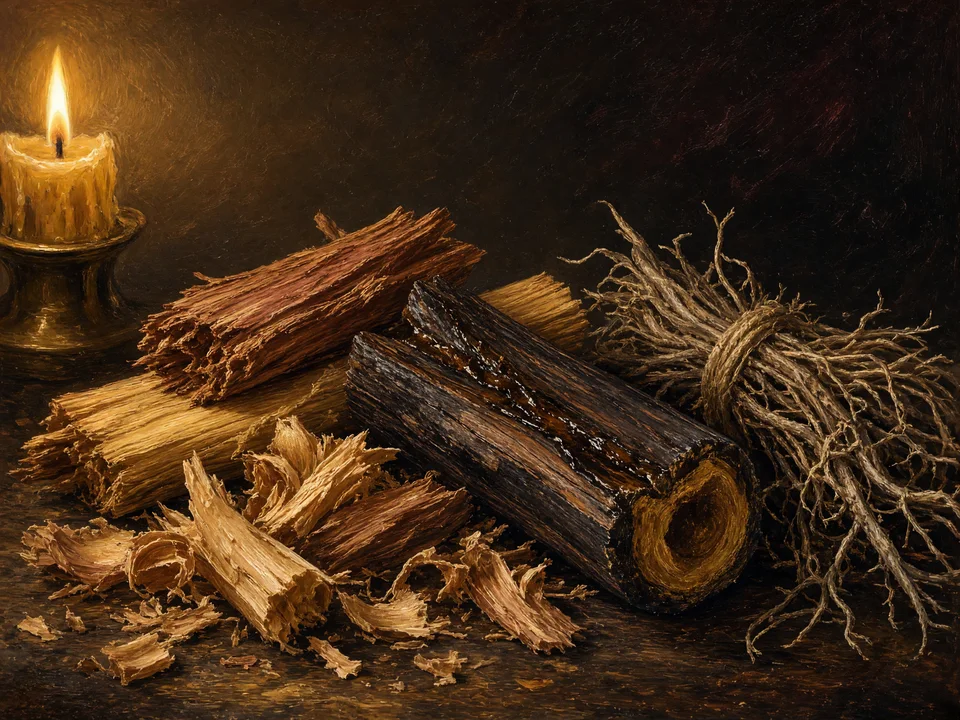
Synthetics also offer solutions to ethical and sustainability problems. Synthetic musks replace animal musk, Ambroxan replaces ambergris, and sandalwood molecules such as Javanol, Polysantol and Ebanol stand in for overharvested Mysore sandalwood.
Headspace: capturing scent in the air
A picked flower and a living flower on the stem do not smell the same. In the headspace technique, a glass dome is placed around the flower, the odor molecules in the air are collected in an absorbent trap, and they are then analyzed by gas chromatography. Developed from the 1970s onward (one of its pioneers was the Givaudan chemist Roman Kaiser), this method made it possible to reconstruct flowers that cannot be extracted, and even the air of a forest or a seashore.
Smelling board: molecules that made history
- Coumarin: Hay, tonka, a hint of almond
- Vanillin: Sweet, creamy vanilla; evokes ice cream
- Aldehydes: Fizzy, soapy, waxy, with a slight metallic sparkle
- Ionones: Powdery violet, iris, a hint of raspberry
- Hedione: Airy, radiant, citrusy jasmine
- Iso E Super: A velvety, dry woody haze close to cedar
- Ambroxan: Mineral, warm, salty skin-like amber
- Galaxolide: Clean laundry, sweet and soft musk
Common misconceptions
- “Synthetic means cheap.” Some synthetics cost more than many essential oils. The price depends on the type of molecule, how hard it is to produce and the dosage used.
- “Natural is less allergenic.” Most known allergens are also found in natural oils. In 2023 the EU significantly expanded its list of fragrance allergens that must be declared on the label; the list makes no distinction between natural and synthetic.
- “Synthetics smell artificial and flat.” When a perfume smells flat, the problem is the formula, not the molecule. Most of the perfumes people find most “natural” are also balanced with synthetics.
- “Expensive perfumes are all natural.” The vast majority of luxury and niche perfumes also use natural and synthetic materials together.
- Aroma chemical
- A single molecule with a defined structure, produced for its smell.
- Nature-identical
- A lab-made version of a molecule that also occurs in nature (e.g., vanillin).
- Isolate
- A single component separated out of a natural oil (e.g., linalool isolated from an oil).
- Headspace
- A technique for collecting and analyzing the odor molecules in the air around an object.
- Specific anosmia
- The inability to smell a particular molecule or group of molecules.
Trace the molecules
- Jicky: Look for the sweetness of coumarin and vanillin beneath the lavender and citrus; one of the first classics to use synthetics boldly.
- No 5 Parfum: The fizzy, soapy brightness of the opening comes from aldehydes; it sits over the floral heart like a layer of light.
- Eau Sauvage: The first major use of Hedione: feel the airy, jasmine-like expansiveness it adds to a citrus cologne structure.
- Molecule 01: Almost nothing but Iso E Super: ideal for getting to know this velvety woody molecule on its own.
- Sauvage: The broad, mineral-amber effect beneath the bergamot and pepper is known for its pronounced use of Ambroxan-type molecules.
Key points
- Synthetic aroma materials are defined molecules that smell the same in every batch; they can be found in nature, semi-synthetic or entirely new.
- Coumarin (1868), vanillin (1874), the ionones (1893), aldehydes (N°5, 1921), Hedione and Iso E Super are milestones of modern perfume.
- Musks went through three generations: nitro, polycyclic and macrocyclic; safety and environmental concerns played a role in each transition.
- Synthetics give a voice to flowers that cannot be extracted and replace animal materials or natural materials that are running out.
- The headspace technique makes it possible to analyze and reconstruct the air around living flowers and places.
Sources
- Sell, C. S. (ed.). The Chemistry of Fragrances: From Perfumer to Consumer. 2nd ed., Royal Society of Chemistry, 2006.
- Ohloff, G., Pickenhagen, W. and Kraft, P. Scent and Chemistry: The Molecular World of Odors. Wiley-VCH / VHCA, 2011.
- Surburg, H. and Panten, J. Common Fragrance and Flavor Materials. 5th ed., Wiley-VCH, 2006.
- Turin, L. The Secret of Scent. Faber and Faber, 2006.
- Kaiser, R. Meaningful Scents Around the World. Wiley-VCH / VHCA, 2006.
- European Union. Cosmetic Products Regulation (EC) No 1223/2009 and amending Regulation (EU) 2023/1545 on fragrance allergens.