Natural raw materials
From plant to bottle: extraction methods, material families and the real cost
Fisfis Academy · 15 min read ·
What you will learn
- Tell apart how steam distillation, cold pressing, solvent extraction, enfleurage and CO₂ extraction work
- Use the terms essential oil, concrete, absolute, resinoid and tincture correctly
- Recognize the citrus, floral, wood, resin and animalic families of raw materials
- Explain why a natural raw material is expensive, variable and sometimes restricted
In perfumery, a natural raw material is an odorous substance obtained by physical methods from a plant, a resin or, historically, an animal. A natural material is not a single molecule but a complex mixture: one rose oil contains hundreds of different components. That complexity gives depth, but it also brings variability: the harvest year, the climate and the processing method all change the scent. This is why a perfumer's first question is always the same: Where did this material come from, and how was it obtained?
- 3–5 tons Roughly the amount of rose petals needed to distill just 1 kg of rose oil
- Hundreds The number of components analysis can detect in a single natural essential oil
- 3+ years Roughly how long orris roots are dried and rested before processing
Extraction methods
Steam distillation is the most common method. Steam passes through the plant material and carries the volatile molecules with it; the mixture condenses in a cooler, and the oil and water separate because of their difference in density. Lavender, patchouli, vetiver, sandalwood and cedarwood oils are made this way.
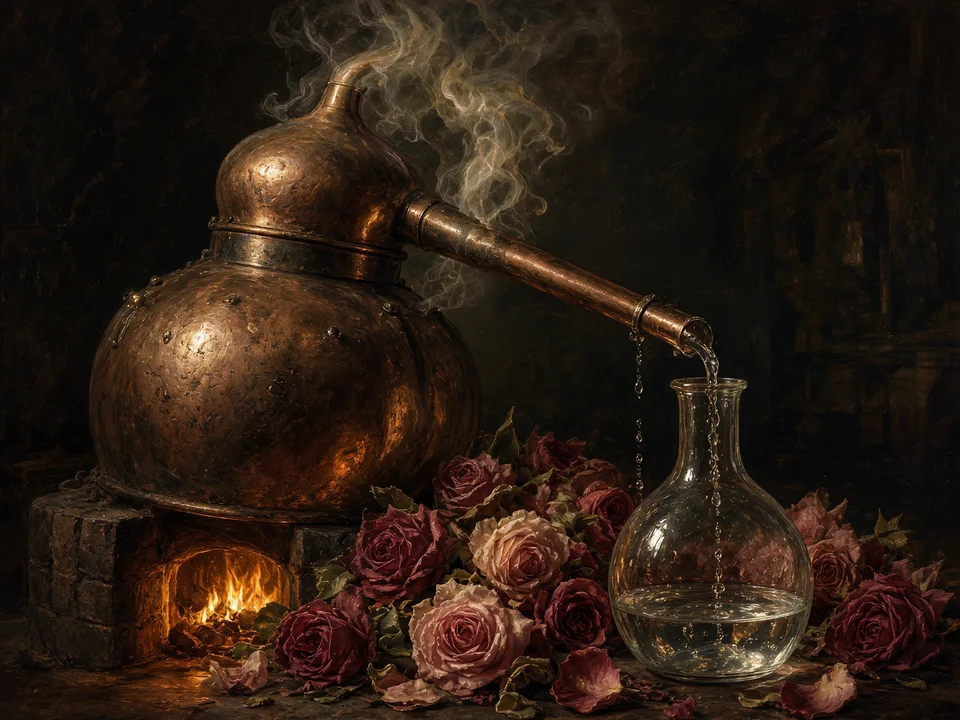
The limit of distillation is heat. Delicate flowers such as jasmine and tuberose either give a very poor yield in distillation or lose their scent. Rose, on the other hand, yields two different products: rose oil (otto), obtained by distillation, and rose absolute, obtained with a solvent. Phenylethyl alcohol, which carries rose's honey-sweet scent, dissolves readily in water, so during distillation it largely stays in the rose water. That is why the absolute smells rounder and more like a “fresh flower,” while the otto smells sharper and brighter.
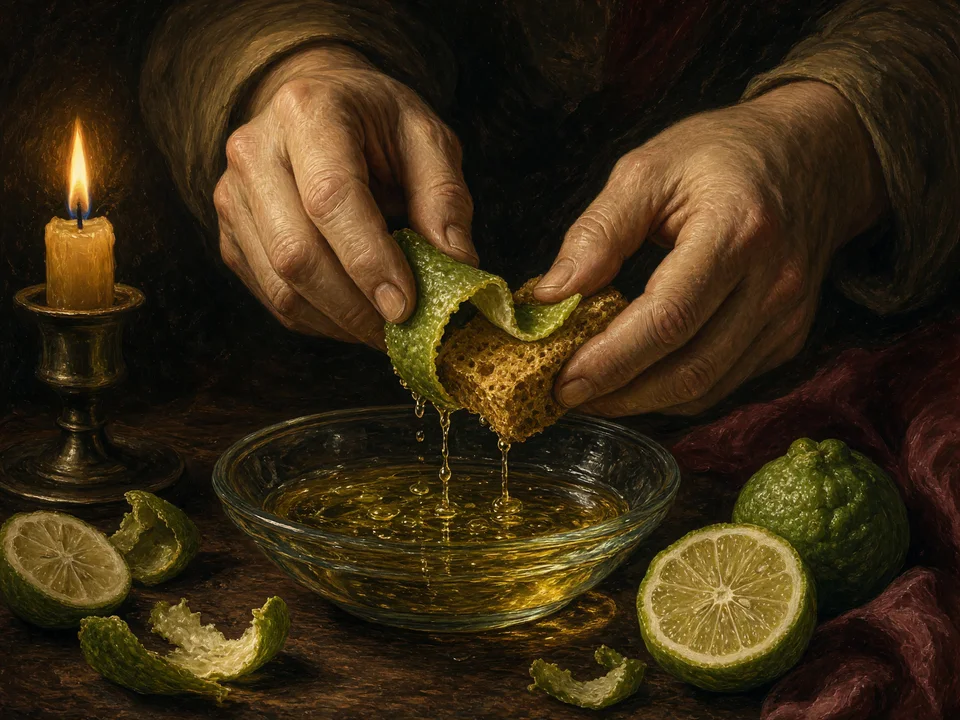
Cold pressing (expression) is specific to citrus. The tiny oil sacs in the peel of bergamot, lemon, orange and mandarin are burst mechanically; because no heat is used, the scent stays very close to the fruit itself.
Solvent extraction is used for heat-sensitive flowers. The flowers are washed with a volatile solvent such as hexane, and once the solvent is removed a waxy mass remains: the concrete. The concrete is treated with ethyl alcohol and chilled to strip out its waxes, leaving a dense, dark liquid: the absolute. When the same process is applied to dry resins, the product is called a resinoid.
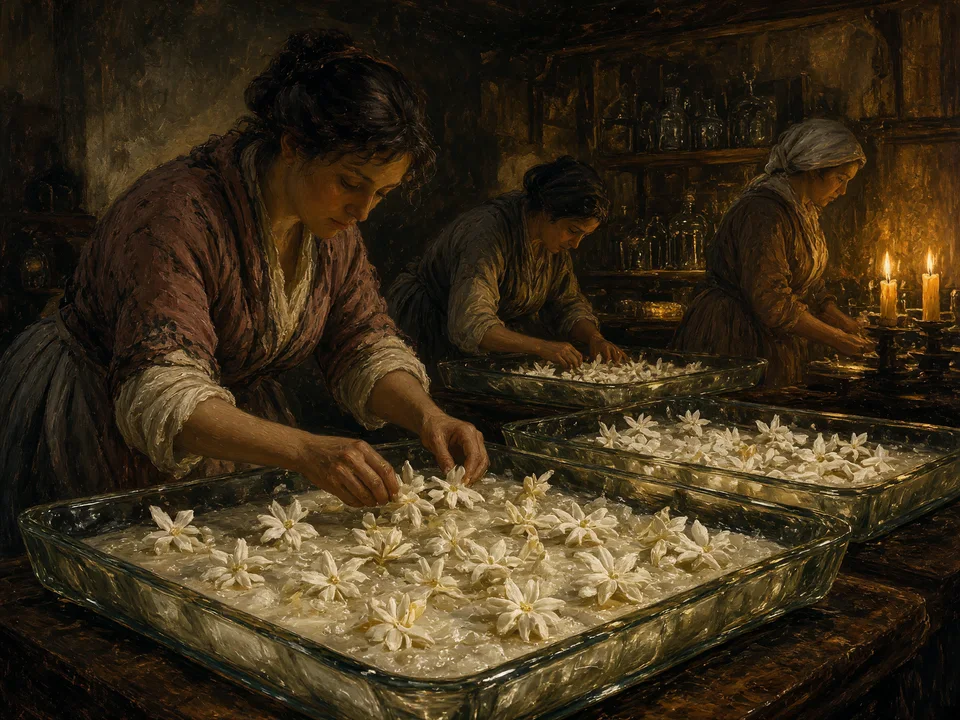
Enfleurage was the technique of the era before solvents. In Grasse, glass plates were coated with pure animal fat, fresh flowers were laid on top, and the flowers were replaced for days. The scent-saturated fat (the pomade) was then washed with alcohol to recover the fragrance. Because it was so labor-intensive, it gave way to solvent extraction in the 20th century; today it is practiced only as a craft or for demonstration.
Supercritical CO₂ extraction is a modern method. Above roughly 31 °C and 74 bar, carbon dioxide becomes a solvent that behaves like both a gas and a liquid; when the process is finished, the pressure is lowered and the CO₂ escapes without leaving a trace. Thanks to the low temperature, CO₂ extracts of spices such as pink pepper, cardamom and ginger smell surprisingly “fresh.” Finally, a tincture is made by steeping a material in alcohol for a long time; vanilla and benzoin tinctures are examples.
Steam distillation
- Product: essential oil and hydrosol
- Examples: lavender, patchouli, vetiver, rose oil
- Pro: widespread and relatively cheap
- Con: heat damages some molecules
Cold pressing
- Product: citrus peel oil
- Examples: bergamot, lemon, orange
- Pro: fresh scent very close to the fruit
- Con: the oil oxidizes over time and has a short shelf life
Solvent extraction
- Product: concrete, absolute, resinoid
- Examples: jasmine, tuberose, mimosa, benzoin
- Pro: preserves the scent of delicate flowers
- Con: dense and dark; solvent residues must be checked
Supercritical CO₂
- Product: CO₂ extract
- Examples: pink pepper, cardamom, vanilla
- Pro: low heat, no solvent residue
- Con: high-pressure, expensive equipment
- Essential oil
- An oil obtained by distillation or pressing that carries the volatile components of the plant.
- Hydrosol
- The lightly scented water that separates from the oil during distillation: rose water, orange flower water.
- Concrete
- The first product of solvent extraction; a solid or semi-solid mass that contains plant waxes along with the odorous substances.
- Absolute
- A concentrated, wax-free fragrance extract obtained by purifying the concrete with alcohol.
- Resinoid
- An extract obtained from resins and balsams with a solvent; it usually acts as a fixative.
- Tincture
- A solution made by steeping a material in alcohol for a long time.
The families of the natural palette
Smelling board: representatives of the natural palette
- Bergamot: Bright, slightly bitter citrus with a floral, faintly tea-like side
- Rose: A rich floral carrying honey, lemon and a touch of spice
- Jasmine: Dense, fruity, slightly animalic (indolic) white flower
- Orris root: Powdery, buttery, with dry violet tones
- Sandalwood: Creamy, milky, soft wood
- Vetiver: Earthy, rooty, slightly smoky and dry
- Benzoin: Vanilla-like, balsamic, warm resin
- Labdanum: A dark, sticky resin that evokes leather and amber
Woods and roots are the skeleton of a formula: cedar is dry and pencil-like, sandalwood creamy, vetiver earthy, and patchouli like dark, damp soil. Resins and balsams (frankincense, myrrh, benzoin, labdanum, tolu and Peru balsam) come from substances that trees secrete when they are wounded; because they evaporate slowly, they carry the base notes and give a fragrance its longevity.
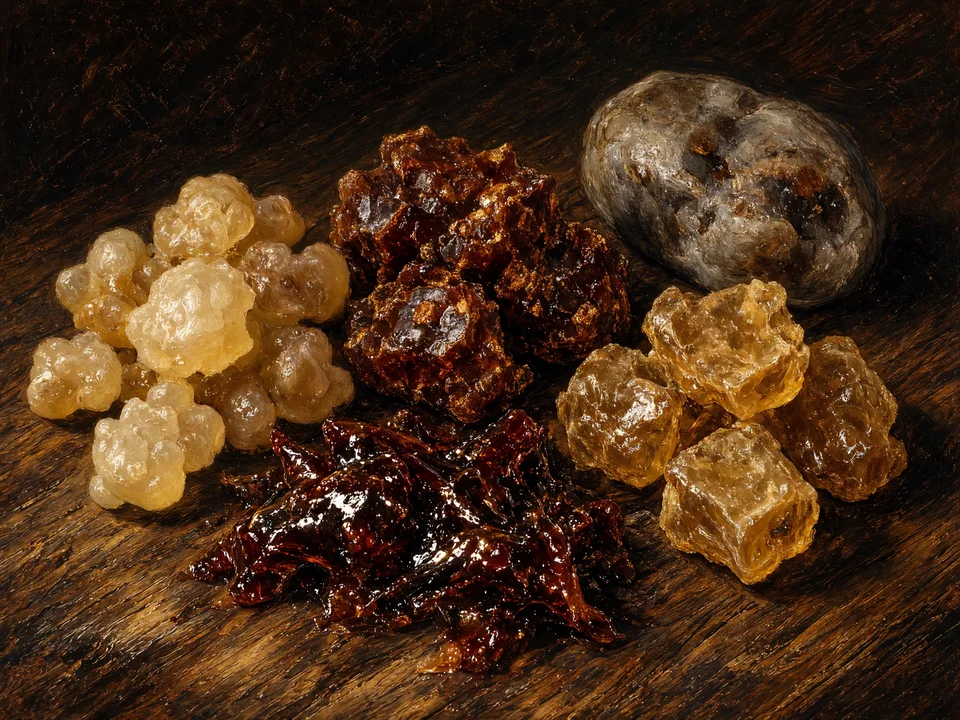
Animalic raw materials once made up the most tenacious layer of perfume: musk from the musk deer, civet from the civet cat, castoreum from the beaver, and ambergris, which forms in the digestive system of the sperm whale and matures while floating at sea. The musk deer is now under international protection (CITES). In modern perfumery these materials have been almost entirely replaced by synthetic musk and amber molecules and by plant-based counterparts such as ambrette seed and labdanum.
Cost, variability and sustainability
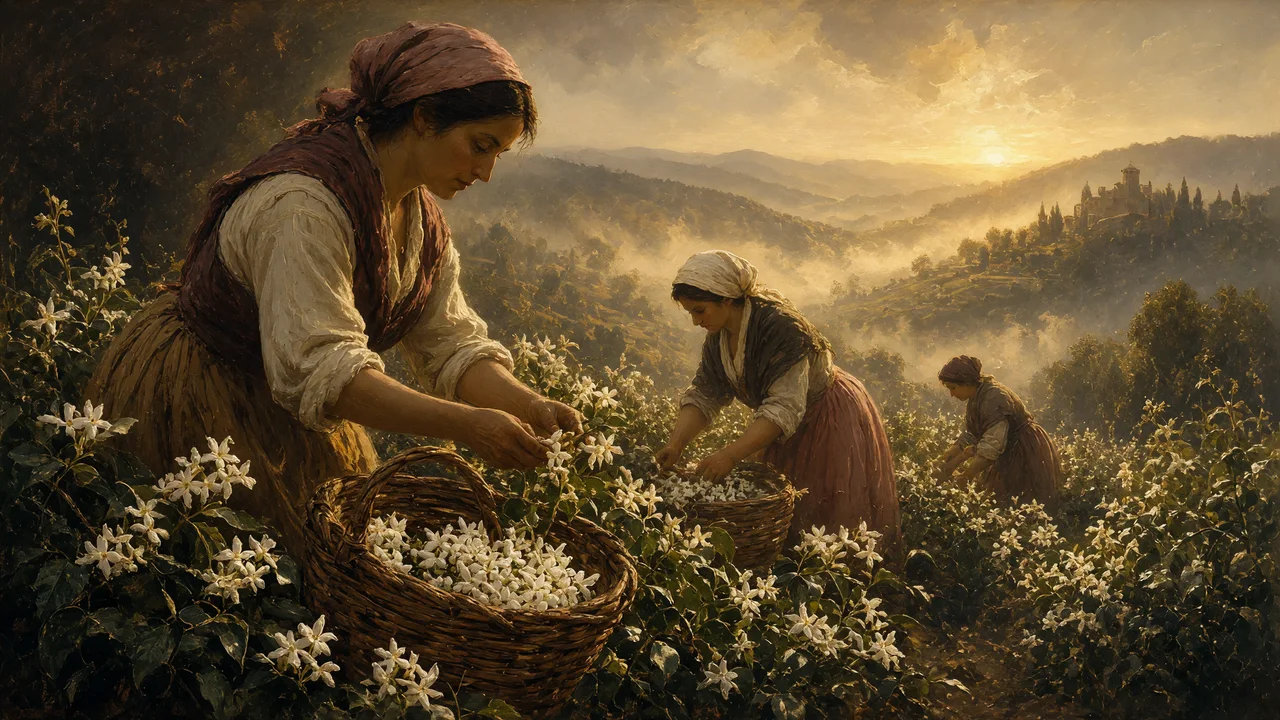
Yield and labor set the price of a natural raw material. Jasmine is picked by hand in the early morning; the rose harvest is squeezed into a season of a few weeks. A bad harvest year can push prices up sharply: cyclones and harvest problems in Madagascar multiplied vanilla prices within a few years.
Perfumes that let you feel natural raw materials
- Portrait of a Lady: An intense pairing of rose and patchouli: notice how the rose's honey and wine tones deepen against the earthy patchouli.
- Shalimar Eau de Toilette: A generous bergamot opening descending into a vanilla, balsamic, resinous base: the classic contrast of citrus and resin.
- Original Vetiver: Get to know vetiver's earthy, rooty character in an easy-to-read form brightened by citrus.
- Tobacco Vanille: A dense, balsamic base of tobacco, vanilla and dried fruit tones: observe how long-lasting heavy raw materials can be.
Key points
- Natural raw materials are not single molecules but complex mixtures of hundreds of components; that is why they are rich but variable.
- The extraction method shapes the scent: the same rose gives an otto by distillation and an absolute by solvent, and the two smell different.
- Citrus is cold-pressed, delicate flowers are solvent-extracted, and woods and leaves are mostly steam-distilled; CO₂ extraction gives fresh results at low heat.
- Animalic raw materials have today been largely replaced by synthetic and plant-based alternatives.
- Natural does not mean safe; natural oils can also contain allergens and phototoxic substances.
Sources
- Arctander, S. Perfume and Flavor Materials of Natural Origin. Elizabeth, NJ, 1960.
- Baser, K. H. C. and Buchbauer, G. (eds.). Handbook of Essential Oils: Science, Technology, and Applications. CRC Press, 2010.
- Calkin, R. R. and Jellinek, J. S. Perfumery: Practice and Principles. Wiley, 1994.
- Sell, C. S. (ed.). The Chemistry of Fragrances: From Perfumer to Consumer. 2nd ed., Royal Society of Chemistry, 2006.
- IFRA (International Fragrance Association). IFRA Standards, current amendment publications.