Nose training
A method for recognizing, naming and remembering smells
Fisfis Academy · 13 min read ·
What you will learn
- Set up a productive smelling session with the right environment, smelling strips and dilutions
- Recognize and manage olfactory fatigue
- Build a lasting scent memory through comparative smelling and writing descriptors
- Follow a four-week starter training plan
A good nose is largely not an inborn talent but the result of training. Perfumers spend years memorizing hundreds of raw materials by smelling them one by one. The same method, on a smaller scale, works for anyone.
Most of us struggle not with perceiving a smell but with naming it. The feeling of “I know this, but I can't put a name to it” is very common. We usually describe smells by their source: “like lemon,” “like rain.” The real goal of nose training is to strengthen this link between smell and word.
Rules for a smelling session
- Environment: Choose an odor-free, well-ventilated, quiet room. Food, cigarettes, candles or perfume on you will skew the results.
- Timing: Work while your nose is fresh; for many people that means the morning. Avoid working right after a heavy meal.
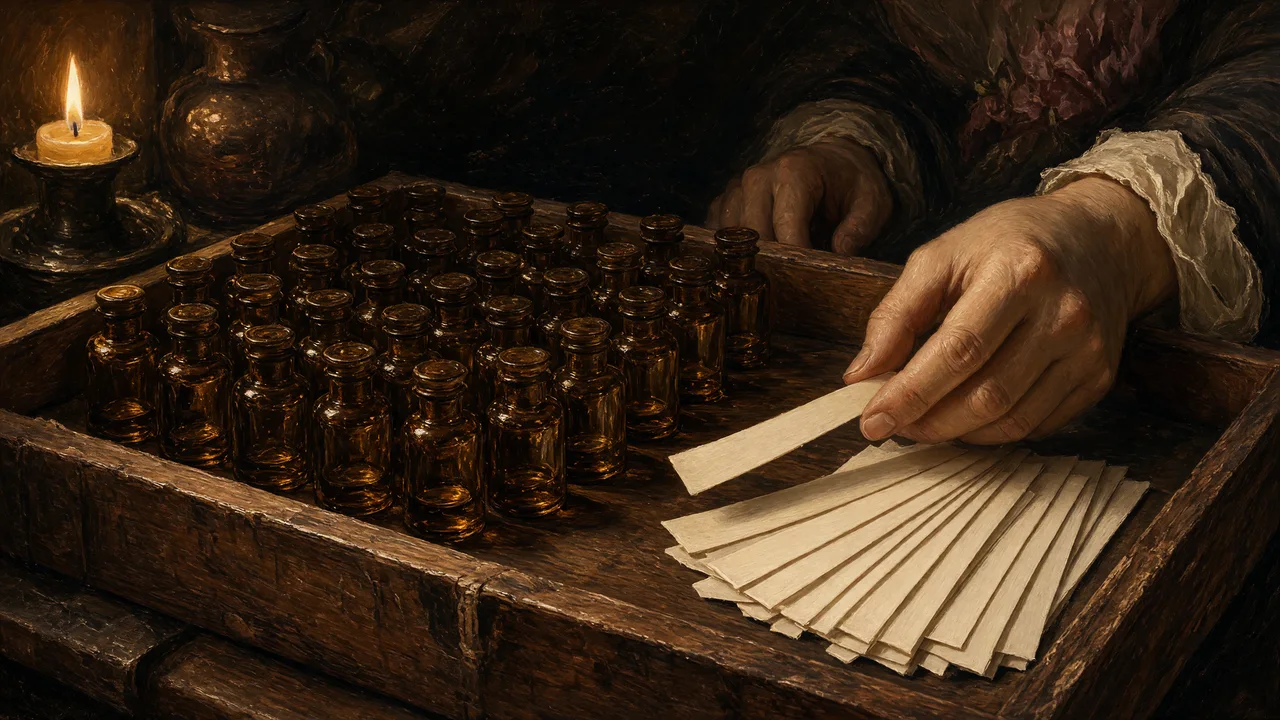
- Smelling strip: Write the material's name and the time on each strip. Dip the strip no more than 1 cm into the liquid and wait a few seconds for the alcohol to evaporate.
- Dilution: Smell raw materials not neat but usually as a 10% solution in alcohol; 1% suits very strong materials better. Dilution brings out details that stay hidden in the neat material.
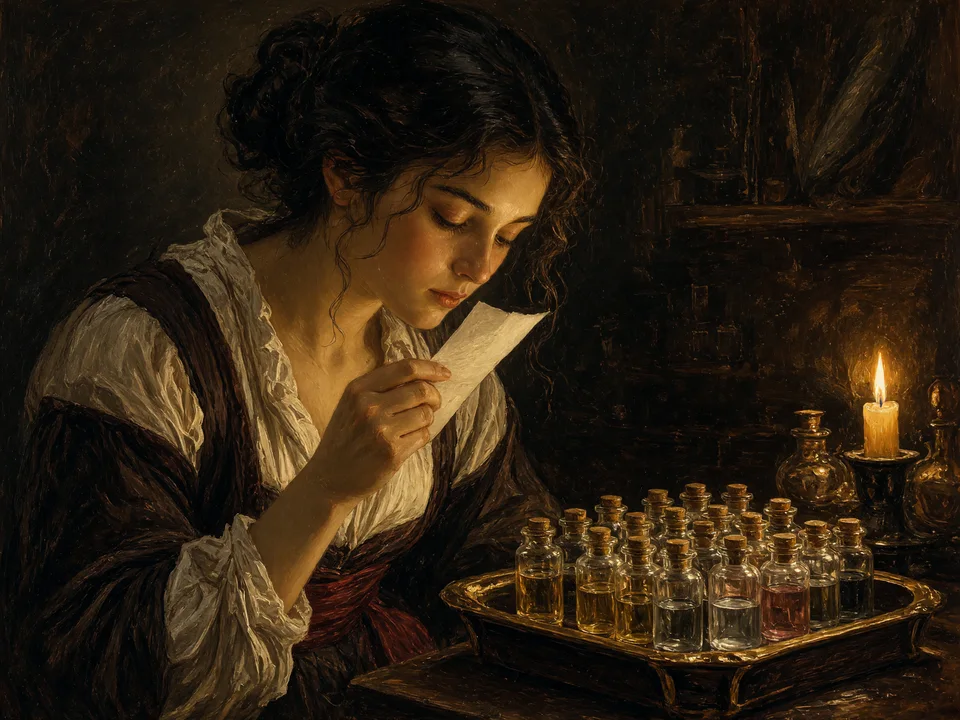
- Smelling technique: Hold the strip a few centimeters below your nose, take a few short, light sniffs, then move it away. Long, deep breaths tire the nose quickly.
- Duration: Six to ten materials and 20–30 minutes per session is enough. Short, regular practice works better than long, infrequent sessions.
Olfactory fatigue
When you are continuously exposed to a smell, the brain treats it as “background,” and perception drops noticeably within a few minutes. This is called olfactory adaptation, or olfactory fatigue. It is also why you stop being able to smell your own perfume after a while.
The fix is simple: take short breaks between materials, get some fresh air every few minutes, or smell the unscented skin of your own arm. Smelling coffee beans is often said to “reset” the nose, but there is no strong evidence that it works better than fresh air.
A starter kit
A kit of 12–20 materials representing the main families is a good start. Don't limit it to naturals: synthetics such as Hedione, Iso E Super, Ambroxan, a musk, coumarin and vanillin are found in most modern perfumes, and knowing them makes reading perfumes much easier.
Smelling board: the first eight materials
- Lemon: Sour, bright, fast-evaporating citrus
- Lavender: Herbal, clean, slightly camphoraceous and floral
- Geranium: Green, rosy, with a hint of mint and lemon
- Ylang-ylang: Creamy, banana-like, exotic white flower
- Cedarwood: Dry wood, like pencil shavings
- Patchouli: Dark, earthy, damp forest floor
- Coumarin: Hay, tonka, warm almond
- White musk: Clean, soft, skin and laundry
Learning by comparison
Smelling a material on its own teaches far less than smelling it next to another material. The classic method developed by Jean Carles, founder of the Roure perfumery school, is built on this idea: first you compare materials that are very different from each other, then you study the fine differences between similar materials in the same family.
Easy pairs
- Lavender and vanilla
- Lemon and cedarwood
- Rose and patchouli
- Goal: tell the families apart
Intermediate pairs
- Lemon and bergamot
- Rose and geranium
- Cedarwood and sandalwood
- Goal: find the character within a family
Hard pairs
- Orange and mandarin
- Jasmine and ylang-ylang
- Iso E Super and cedarwood
- Goal: name the fine detail
Memory techniques
- Write descriptors: For each material, note qualities like color, texture, temperature and weight alongside the smell: “cold, thin, green, sharp,” for example.
- Add personal associations: Your own memories, like “my grandmother's wardrobe” or “the garden after rain,” are powerful hooks in scent memory.
- Do blind tests: Have a friend label the strips with numbers only; you guess, and record your accuracy rate.
- Spaced repetition: Smell a new material again 1, 3 and 7 days after you learn it. The gaps between repetitions strengthen memory.
- Match in the real world: Look for the notes you have learned at the produce stand, in the garden, in the kitchen. Nose training continues away from the smelling table.
- Descriptor
- A shared word used to describe a smell: woody, powdery, green, metallic and so on.
- Olfactory adaptation
- The temporary drop in perception of a smell you are continuously exposed to; olfactory fatigue.
- Dilution
- Thinning a raw material to a set ratio with alcohol or another solvent.
- Blind test
- A recognition exercise in which the names of the smells are hidden.
- Anosmia
- Loss of the sense of smell; specific anosmia is anosmia to particular molecules only.
A four-week starter plan
- Week 1: Families Pick 8 materials (citrus, aromatic, floral, wood, resin, musk). Every day, spend 15 minutes smelling the easy pairs side by side, and write three descriptors for each material.
- Week 2: Differences within a family Focus on the citrus and floral families: lemon, bergamot, orange; rose, jasmine, geranium. Work on the intermediate pairs and compare your notes with the previous week.
- Week 3: Time and synthetics Add Hedione, Iso E Super, Ambroxan and a musk. Smell the same strips right away, then after 1 hour, 4 hours and 24 hours: note how long each material lasts.
- Week 4: Blind tests and real perfumes Do a short blind test every day and record your accuracy rate. Try to pick out the materials you have learned in simply structured perfumes.
Easy-to-read perfumes for nose training
- Diorissimo: The classic portrait of lily of the valley, a flower that cannot be extracted: ideal for recognizing a structure built around a single flower.
- Pour Un Homme de: A simple structure built on a pairing of lavender and vanilla; try to pick out the two main components separately.
- Philosykos Eau de Toilette: The green, milky side of fig leaf and woody tones: an exercise in breaking a familiar association into its parts.
- Not A Perfume: Built on a single amber molecule (Cetalox); learn to recognize Ambroxan-type materials and find them in other perfumes too.
Key points
- Nose training takes method more than talent; the difficulty lies not in perceiving a smell but in naming and remembering it.
- An odor-free space, labeled smelling strips, diluted raw materials and short sessions are the foundation of productive practice.
- Olfactory fatigue sets in within a few minutes; breaks and fresh air are the simplest remedy.
- Comparative smelling (contrasts first, then similar materials), writing descriptors and spaced repetition strengthen memory.
- Adding key synthetics alongside naturals to a starter kit makes real perfumes easier to read.
Sources
- Calkin, R. R. and Jellinek, J. S. Perfumery: Practice and Principles. Wiley, 1994.
- Jellinek, P. The Practice of Modern Perfumery. Leonard Hill, 1954.
- Herz, R. The Scent of Desire: Discovering Our Enigmatic Sense of Smell. William Morrow, 2007.
- Ohloff, G., Pickenhagen, W. and Kraft, P. Scent and Chemistry: The Molecular World of Odors. Wiley-VCH / VHCA, 2011.