A safe workspace
Set up your bench, equipment and habits with lab discipline
Fisfis Academy · 12 min read ·
What you will learn
- Recognize the main risks of making perfume at home (fire, skin sensitization, vapors, misuse)
- Arrange a workbench properly for ventilation, storage and cleanup
- Know the basic equipment list and why each tool is needed
- Make reading the Safety Data Sheet (SDS) and IFRA certificate a habit
Making perfume can look like a kitchen hobby, but the materials you work with are far more concentrated than anything in a kitchen. A pure essential oil or aroma chemical is tens or even hundreds of times stronger than it will be in the finished perfume. That is why the first rule of the workshop is not creativity but order.
Four basic risks
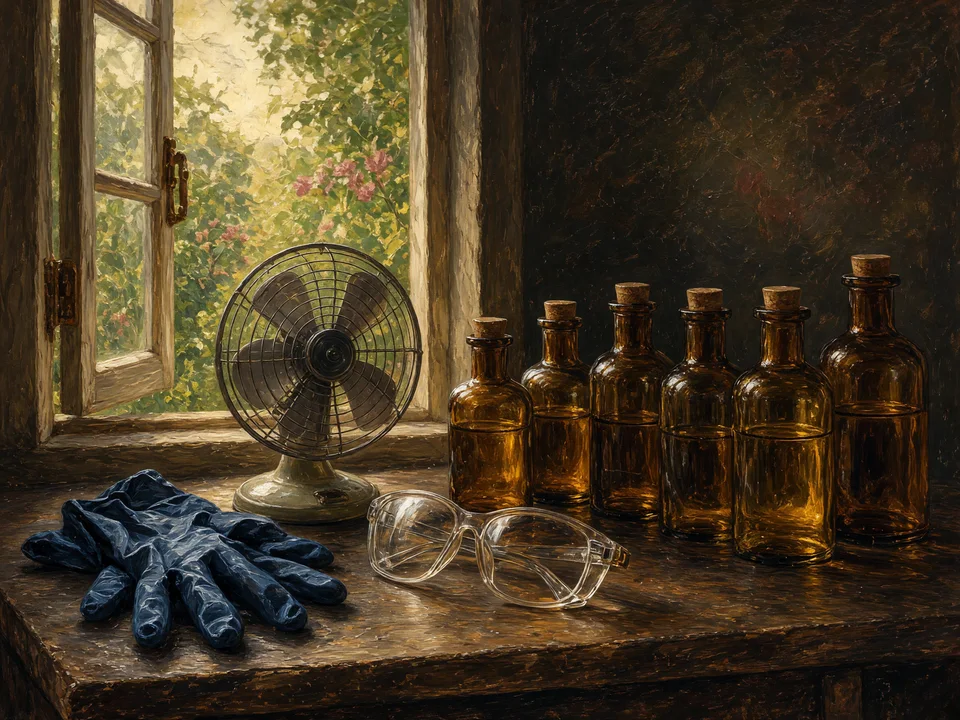
- Flammability: Perfumer’s alcohol (ethanol) gives off vapor that can ignite even at room temperature; its flash point is around 13 °C. Keep open flames, stoves, cigarettes and spark-producing devices away from the work area.
- Skin sensitization: Many natural and synthetic fragrance materials can cause an allergic reaction when they touch the skin undiluted. Once sensitization develops, it is usually permanent.
- Vapors and eye irritation: Breathing heavy vapors in a closed room for a long time can cause headaches and irritation; a single splashed drop can burn the eye.
- Misuse: Unlabeled bottles get mixed up, and small bottles left where children or pets can reach them pose a poisoning risk. Perfume materials are never swallowed or added to food.
Setting up your bench
- Choose a spot Pick a well-ventilated corner with a window, separate from the kitchen and bedroom. It should not be near a stove, fireplace, candle or electric heater.
- Protect the surface Alcohol and oils damage varnished wood and some plastics. Cover the table with glass, ceramic or an easy-to-wipe mat, and lay absorbent paper towels underneath.
- Have protective gear ready Keep nitrile gloves, safety goggles and an apron (or a shirt you wear only for this work) next to the bench. Tie back long hair.
- Set up separate storage Store raw materials in a cool, dark, lockable cabinet, in tightly closed amber glass bottles. Keep alcohol in small volumes and away from heat sources.
- Label everything Write the material name, dilution, solvent and date on every bottle. The bottle you plan to “label later” is the bottle nobody recognizes a week from now.
- Plan for spills Keep paper towels, a waste container with a lid and water within reach. Wipe up spills immediately, air out the room, collect soiled towels in a closed container and dispose of them according to household waste rules.
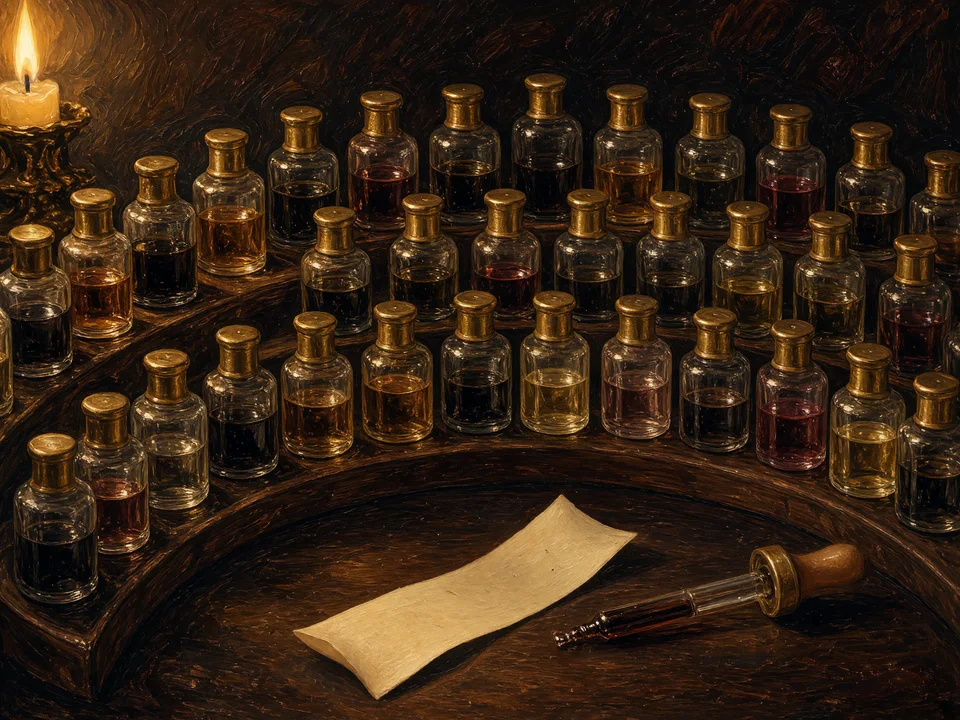
A professional perfumer’s workbench is called an organ; the bottles are lined up on tiered shelves like the keyboards of an organ. You can build a small version at home: group your materials by scent family (citrus, floral, woody, resinous, musk…). You will find what you need faster and be less likely to open the wrong bottle.
Basic equipment
Must-haves
- Digital scale with 0.01 g precision
- Glass beakers and amber glass bottles with screw caps
- Disposable plastic or glass pipettes
- Scent strips (mouillettes)
- Nitrile gloves, goggles, labels and a pen
- Perfumer’s alcohol and/or DPG (dipropylene glycol)
Things to avoid
- Using kitchen utensils for perfume work (and then returning them to cooking)
- Thin plastic containers: some materials dissolve plastic
- Putting fragrance in misleading containers such as water bottles or medicine bottles
- Working next to the stove or in a closed, stuffy room
- Bringing your nose up to the bottle to smell a material neat
SDS and IFRA: know these two documents
A reputable supplier provides a Safety Data Sheet (SDS, formerly MSDS) for every raw material it sells. This document covers hazard classes, first aid, storage and fire information. Many suppliers also provide an IFRA certificate showing the material’s usage limits under the IFRA Standards.
IFRA (the International Fragrance Association) bans some substances outright, restricts others by product category and sets purity requirements for still others. Perfume applied to the skin falls under “Category 4.” Checking a material’s limit before you put it in a formula is a good habit.
- ~13 °C Approximate flash point of ethanol: room temperature is above it
- 0.01 g Recommended scale precision for a home workshop
- Cat. 4 IFRA product category for perfume applied to the skin
Smelling hygiene
- Dip the scent strip into a drop you have taken with a pipette, not into the bottle; write the material name and the time on the strip.
- Smell a limited number of materials per session; when your nose tires (olfactory fatigue), take a break and get some fresh air.
- Sniffing coffee beans is a common habit, but the scientific support for it is weak; you can use the smell of your own skin or fresh air as your “zero point.”
- When you finish, take off your gloves, wash your hands with soap, close the bottles and put them back in the cabinet.
- SDS
- Safety Data Sheet: a standard document covering a chemical’s hazards, storage and first-aid information.
- IFRA
- International Fragrance Association; the industry body that sets safe-use limits for fragrance materials.
- Sensitization
- An allergic response the immune system develops after repeated contact with a substance.
- Flash point
- The lowest temperature at which a liquid’s vapor can be ignited by a source of fire.
- Organ
- The tiered workbench on which a perfumer arranges raw materials.
- Mouillette
- A thin, absorbent paper strip used for testing scents.
Key points
- Perfume raw materials are concentrated: never apply them neat to the skin, swallow them or inhale deeply straight from the bottle.
- Ethanol is highly flammable; there should be no open flames or heat sources in the work area.
- A separate, well-ventilated corner, nitrile gloves, goggles and labeled amber glass bottles make up the basic setup.
- Get the SDS and, where possible, the IFRA certificate for every material; “natural” does not always mean safe.
- Store materials in a cool, dark cabinet out of reach of children and pets.
Sources
- Curtis, T. & Williams, D. G. (2001). Introduction to Perfumery (2nd ed.). Micelle Press.
- Calkin, R. R. & Jellinek, J. S. (1994). Perfumery: Practice and Principles. Wiley.
- Tisserand, R. & Young, R. (2014). Essential Oil Safety (2nd ed.). Churchill Livingstone.
- IFRA (International Fragrance Association). IFRA Standards, current amendment and category guidance.
- ECHA. Guidance on the Compilation of Safety Data Sheets (REACH, Annex II).