Dilution and writing formulas
Weighing in grams, 10% and 1% dilutions, parts and per-mille math
Fisfis Academy · 14 min read ·
What you will learn
- Explain why we work in grams rather than drops
- Prepare 10% and 1% dilutions of a material correctly
- Write a formula in parts, per mille (‰) and percent, and convert between them
- Calculate the actual (neat) amount of a material added as a dilution
A perfume formula is less like a cooking recipe and more like a prescription: how much of each material is used has to be written down in a way that can be repeated. A formula you cannot repeat, however good it smells, is an accident that happened once.
Grams, not drops
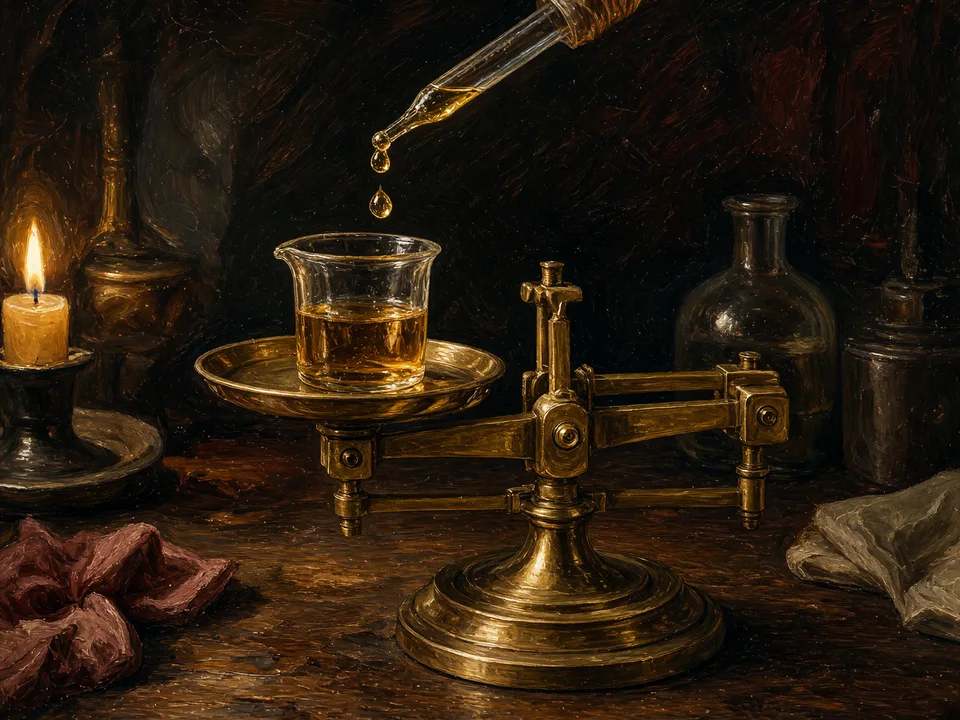
Drops sound practical, but they are not reliable. The weight of a drop changes with the material’s density and viscosity and with the tip of the pipette: drops of a thick resin and a thin citrus oil are not the same. That is why professional labs write and weigh formulas by weight (in grams).
Working in drops
- Drop weight varies with the material and the pipette
- The same formula never gives the same result twice
- Scaling up (e.g., from 10 g to 100 g) magnifies errors
- Only usable for rough first trials
Working in grams
- Repeatable results with a 0.01 g scale
- The formula converts directly to percent and per mille
- Scaling up is simple multiplication
- Checking IFRA limits becomes possible
Why do we dilute?
Many fragrance materials are so powerful neat that even a few milligrams can throw off the balance. On a 0.01 g scale, the smallest amount you can weigh is already 10 milligrams. If you dilute the material beforehand to 10% or 1%, you can make adjustments 10 or 100 times finer on the same scale. Dilution also turns solid materials (e.g., vanillin, coumarin) into liquids and makes smelling easier.
- Weigh the bottle and tare Place a clean, labeled glass bottle on the scale and tare it (zero it). Have your gloves and goggles on.
- Add the material For a 10% dilution, weigh 1.00 g of material. Add it slowly with a pipette; if you overshoot, do not take any back out, recalculate the target instead.
- Top up with solvent Add perfumer’s alcohol or DPG until the total reaches 10.00 g (that is, 9.00 g of solvent). For a 1% dilution, bring 0.10 g of material up to 10.00 g.
- Mix and let it dissolve Cap the bottle and shake gently. Wait until solid materials have fully dissolved; if needed, hold the bottle in warm water (never over a flame).
- Label and record Write “Material – 10% – alcohol (or DPG) – date” on the label. Note the same information in your notebook.
Alcohol or DPG?
Perfumer’s alcohol (ethanol)
- Evaporates quickly and opens the scent on paper and skin
- The main carrier of the finished perfume
- Highly flammable; must be kept tightly closed
- Dilutions can slowly evaporate and become more concentrated over time
DPG (dipropylene glycol)
- A nearly odorless, slow-evaporating solvent
- Dilutions keep their concentration for a long time
- Does not ignite as easily as alcohol
- Can make a scent seem “heavier” on paper; not the main solvent for spray perfume
Materials usually used diluted
- Aldehydes: Sharp and fatty when neat; at 1%, a soapy, bright sparkle.
- Galbanum: Green, bitter and extremely diffusive; even a few milligrams are noticeable.
- Vanillin: A crystalline solid; once dissolved, a sweet, creamy vanilla.
- Labdanum: A dark, sticky resin; when diluted, warm leather and amber tones.
- Oakmoss: Damp forest floor and ink; very strong and restricted by IFRA.
Writing the formula: parts, per mille, percent
Formulas are usually written in parts: “Bergamot 30, Rose 20, Patchouli 10” means these materials are in a 30:20:10 ratio by weight. If you bring the total to 1000, each number becomes a per mille (‰) value directly; bring it to 100 and it becomes a percent. The per-mille system is common because it lets you write small amounts without decimals.
Be careful when calculating a material added as a dilution: if the formula says “Galbanum 10% – 20 parts,” the concentrate actually contains 2 parts of neat galbanum. When you check IFRA limits, you always use this neat amount.
- 1 : 9 10% dilution: 1 g material + 9 g solvent
- 1 : 99 1% dilution: 0.1 g material + 9.9 g solvent
- ‰ Per mille: a formula written so the total is 1000 parts
- Dilution
- A material thinned to a set ratio in a solvent (e.g., 10% in alcohol).
- Tare
- The weight of the container; zeroed on the scale so it is subtracted from the weighing.
- Part
- The unit that expresses the weight ratio between materials in a formula.
- Per mille (‰)
- A material’s share in a formula whose total is taken as 1000.
- Concentrate (oil)
- The blend of all the fragrance materials before it is diluted with alcohol.
- DPG
- Dipropylene glycol; an odorless, slow-evaporating solvent commonly used for dilutions.
Key points
- Formulas are written in grams, not drops, and weighed on a 0.01 g scale.
- A 10% dilution is 1 g material + 9 g solvent; a 1% dilution is 0.1 g material + 9.9 g solvent.
- Parts, per mille and percent are different ways of writing the same ratio; making the total 1000 simplifies the math.
- Calculate the neat amount of any material added as a dilution; IFRA checks are based on the neat amount.
- Never heat ethanol over a flame; label every dilution with its ratio, solvent and date.
Sources
- Curtis, T. & Williams, D. G. (2001). Introduction to Perfumery (2nd ed.). Micelle Press.
- Calkin, R. R. & Jellinek, J. S. (1994). Perfumery: Practice and Principles. Wiley.
- Arctander, S. (1969). Perfume and Flavor Chemicals (Aroma Chemicals). Montclair, NJ: published by the author.
- Aftel, M. (2001). Essence and Alchemy: A Book of Perfume. North Point Press.
- IFRA (International Fragrance Association). IFRA Standards and guidance on the IFRA Certificate of Conformity.