Analyzing a perfume
A structured smelling protocol over time
Fisfis Academy · 13 min read ·

What you will learn
- Observe a perfume systematically at 0, 15 and 60 minutes, 4 hours and the next day
- Identify accords and the olfactory family
- Distinguish between longevity, projection and sillage
- Write a consistent, readable smelling note
- Know what professional analyses such as GC-MS can and cannot tell you
Liking a perfume and analyzing it are different things. Analysis tries to explain what you are smelling, how the scent changes over time and why it smells the way it does. The goal is not to guess the official note list but to understand the perfume's structure.

Preparation
- Strip and skin together: A smelling strip shows the structure more cleanly; skin shows how the perfume behaves in real life. Follow both in parallel.
- Few perfumes: Analyze no more than two or three perfumes per session; more than that tires the nose and muddles your notes.
- An unscented start: Make sure there is no lotion or other perfume on your skin.
- An unbiased first impression: Write your first notes without looking at the official note list; leave the comparison for the very end.
The time protocol
- 0 min – Opening: After spraying, wait a few seconds for the alcohol to evaporate. First impression: citrus, aldehydes, fresh spices, green notes. Is it bright, harsh, sweet?
- 15 min – Transition: The opening settles and the heart emerges. Write down what fades and what appears; is the transition smooth or abrupt?
- 60 min – Heart: This is where the perfume's character can be read. Identify the olfactory family and the main accord at this stage.
- 4 hours – Dry down: Woods, musk, amber, resin and vanilla come forward. Make your first solid judgment about longevity and projection here.
- Next day – Trace: What remains on the strip is the formula's most tenacious skeleton: musks, Ambroxan-type amber molecules, resins and fixatives.
Reading the structure: accords and families
It is more productive to read a perfume through its accords than note by note. An accord is a group of materials that together create a new impression. Each of the classic families rests on a recognizable accord skeleton; once you know these skeletons, you can quickly see which tradition a perfume belongs to.
Chypre
- Bergamot opening
- Labdanum and oakmoss base
- Often patchouli
- Impression: dry, mossy, elegant and serious
Fougère
- Lavender
- Coumarin
- Oakmoss and geranium
- Impression: aromatic, clean, barbershop
Amber (oriental)
- Vanilla and benzoin
- Labdanum and resins
- Often spices
- Impression: warm, sweet, enveloping and dense
Smelling board: the building blocks of classic accords
- Bergamot: The bright light of chypre and fougère openings
- Labdanum: The dark, leathery resin of chypres and ambers
- Oakmoss: Damp forest floor, ink, a hint of the sea
- Patchouli: Earthy, cocoa-like, dark leaf
- Lavender: The herbal, clean backbone of the fougère
- Tonka bean: A source of coumarin: hay, almond, caramel
- Vanilla: The sweet, creamy heart of the amber family
- Benzoin: Balsamic, vanilla-like, warm resin
Performance
- Longevity
- How long the perfume can be detected on skin or on a strip.
- Projection
- How far the scent reaches from the skin; does someone sitting close notice it, or someone across the room?
- Sillage
- The trail of scent left in the air after the wearer has passed.
- Dry down
- The base stage that remains once the opening and heart have faded.
- Linear perfume
- A structure that smells much the same from start to finish, with no marked change.
Performance does not depend on the formula alone: skin type, ambient temperature, the amount sprayed and the concentration all change the result. Not being able to smell your own perfume after a while doesn't mean it has worn off, either; most of the time it is simply olfactory adaptation. That is why asking someone else about projection is more reliable than trusting your own nose.
Writing a smelling note
- Identity The perfume's name, brand, year, concentration and test conditions: strip or skin, how many sprays, ambient temperature.
- Opening What is there in the first few minutes? Describe it with three or four descriptors, such as “bright, slightly bitter, green citrus.”
- Heart At around one hour, write down the perfume's character and main accord. Identify its family here.
- Dry down Describe the base that remains at four hours and beyond; add what is left on the strip the next day.
- Structure Is the perfume linear, or does it go through distinct phases? Is contrast or harmony in the foreground?
- Performance Note longevity in hours, and projection and sillage on a simple scale such as “close, moderate, strong.”
- Assessment What does it do well, and what does it leave missing? Which season, setting or person does it suit? Write your personal preference last, and separately.
Professional analysis: GC-MS
In the laboratory, perfumes are examined by gas chromatography-mass spectrometry (GC-MS). Gas chromatography separates the mixture into its components along a thin column; mass spectrometry identifies each component by its fragmentation pattern. The result is a graph in which each peak represents a molecule: the chromatogram.
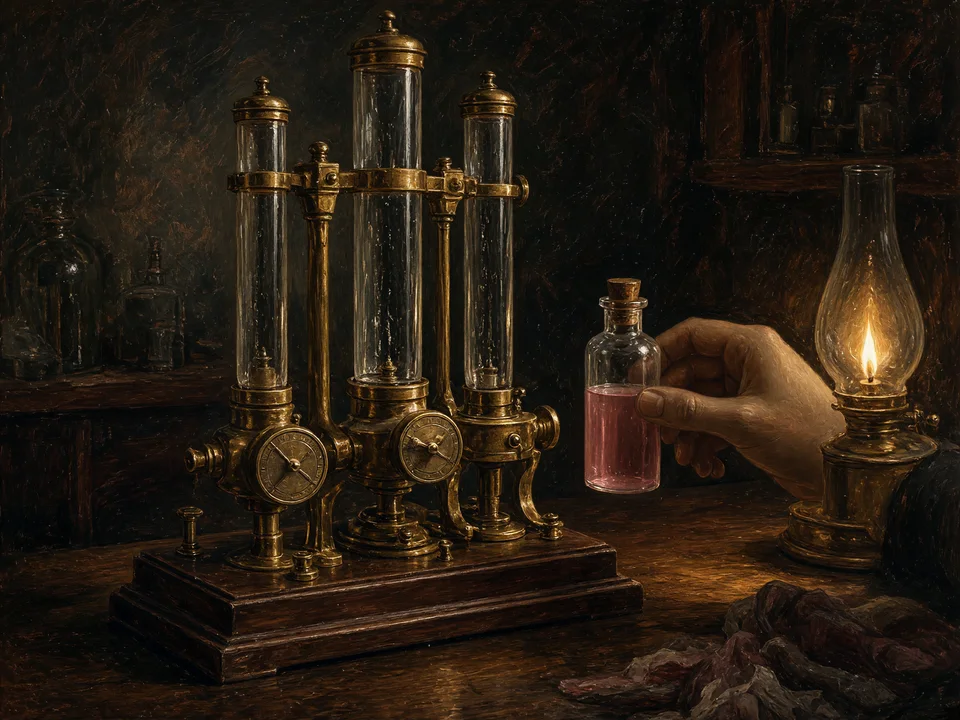
GC-MS is powerful but not limitless. Because natural extracts contain hundreds of components, it is hard to work out which natural oil was used; materials present in very small amounts but with a very strong smell can slip through. That is why laboratories also use GC-olfactometry, in which an expert smells the separated components. The machine tells you what is there; the nose still decides what matters.
Perfumes for analysis practice
- Mitsouko Eau de Toilette: A classic chypre structure: follow over several hours how the peachy fruit tone settles onto a mossy, woody body.
- Coco Mademoiselle: A structure often called a modern chypre: note the shift from a citrus opening to a clean patchouli and musk dry down.
- Angel: A clash between caramel-like sweetness and earthy patchouli; be sure to smell the trace left on the strip the next day.
- Terre d'Hermès Hermès: A clear structure built from few elements: the move from an orange-grapefruit opening to a vetiver and mineral-woody dry down.
- Aventus: Observe the balance between a fruity opening and a smoky birch and musky dry down, and how projection fades over the hours.
Key points
- Analysis means observing a perfume's structure over time; the goal is not to guess the note list.
- A fixed time protocol (0, 15 and 60 minutes, 4 hours, the next day) makes a perfume's story comparable.
- Families such as chypre, fougère and amber rest on recognizable accord skeletons; knowing these skeletons speeds up reading.
- Longevity, projection and sillage are different concepts; skin, temperature, dose and olfactory adaptation affect the result.
- GC-MS separates and identifies a perfume's components, but it still takes a trained nose to decide what matters in the scent.
Sources
- Calkin, R. R. and Jellinek, J. S. Perfumery: Practice and Principles. Wiley, 1994.
- Sell, C. S. (ed.). The Chemistry of Fragrances: From Perfumer to Consumer. 2nd ed., Royal Society of Chemistry, 2006.
- Turin, L. and Sanchez, T. Perfumes: The Guide. Viking, 2008.
- Ohloff, G., Pickenhagen, W. and Kraft, P. Scent and Chemistry: The Molecular World of Odors. Wiley-VCH / VHCA, 2011.
- Baser, K. H. C. and Buchbauer, G. (eds.). Handbook of Essential Oils: Science, Technology, and Applications. CRC Press, 2010.