First accords
Chypre, fougère and amber skeletons: a cohesive scent from a few materials
Fisfis Academy · 16 min read ·
What you will learn
- Explain what an accord is and why it behaves differently from individual notes
- Recognize the building blocks of the classic chypre, fougère and amber accords
- Weigh out a simple accord on a small scale and evaluate it on a scent strip
- Take IFRA into account for restricted materials such as oakmoss, bergamot and coumarin
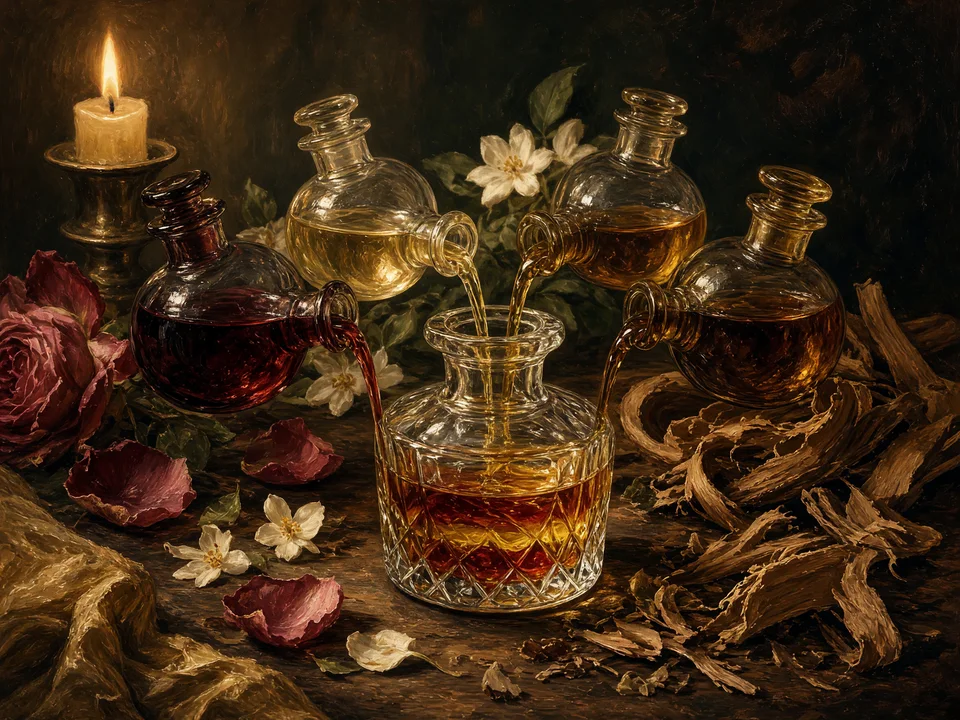
An accord is what happens when several materials combine to create a new impression that resembles none of them on its own. It works like music: play C, E and G separately and you hear three notes; play them together and you hear a single color. Most perfumers think in terms of these small building blocks, not individual materials, when they write a formula.
Three classic families, three skeletons
Chypre
- A bright citrus opening: bergamot
- A floral heart: rose, jasmine
- A mossy, woody base: oakmoss, patchouli, labdanum
- Built on contrast, “dry” and elegant
Fougère
- An aromatic opening: lavender, bergamot
- Light floral support: geranium
- A sweet, hay-like base: coumarin (tonka), oakmoss
- A “fern” fantasy; the foundation of classic men’s fragrances
Amber (oriental)
- Warm resins: labdanum, benzoin
- Sweetness: vanillin, vanilla
- Depth: patchouli, tonka
- Soft, enveloping and long-lasting
Building blocks of the accords
- Bergamot: Somewhere between tea and citrus, a sparkling opening.
- Rose: A full, slightly spicy and powdery flower.
- Patchouli: Earth, cocoa and damp forest floor.
- Oakmoss: Inky, mossy, like a rock on the seashore.
- Lavender: Clean, herbal, with a slightly camphoraceous freshness.
- Coumarin: Dry hay and almond; sweet but not gourmand.
- Labdanum: Warm, resinous, with leather and amber tones.
- Benzoin: A vanilla-like, balsamic, slightly sweet resin.
Example 1: Chypre skeleton (100 parts)
- Bergamot (bergapten-free, FCF) – 35
- Rose (rose oil or a ready-made rose base) – 20
- Hedione (a transparent molecule that gives a jasmine impression) – 10
- Patchouli – 15
- Labdanum (50% dilution) – 8
- Oakmoss substitute (e.g., Evernyl 10%) or low-atranol oakmoss – 10
- Musk (e.g., a macrocyclic musk) – 2
Example 2: Fougère skeleton (100 parts)
- Lavender – 35
- Bergamot (FCF) – 20
- Geranium – 10
- Coumarin (pre-dissolved, neat amount) – 8
- Oakmoss substitute (10%) – 8
- Vetiver – 12
- Musk – 7
Example 3: Amber skeleton (100 parts)
- Labdanum (resinoid or absolute, diluted) – 35
- Benzoin (resinoid) – 30
- Vanillin (10% dilution) – 12
- Patchouli – 8
- Tonka / coumarin – 5
- Bergamot (FCF) – 10
Weighing and reading an accord
- Start small Weigh accords at small scales, such as 2–5 g. A 100-part formula at 5 g works out to 0.05 g per part, a comfortable range for a 0.01 g scale.
- Skeleton first, then ornament First try the two main materials (e.g., bergamot and patchouli) in different ratios. Once you find the balance, add the third. Starting with seven materials at once hides the source of any mistake.
- Dilute the concentrate Dilute the accord concentrate to 10–20% in alcohol; a neat concentrate overpowers everything, even on paper.
- Smell over time Dip a scent strip and write the name on it; smell it right away, after 15 minutes, after 1 hour and the next day. Note how the accord changes.
- Adjust one variable at a time In each new trial, change the ratio of only one material and number your trials (A1, A2, A3…). That way you learn what each change does.
Hear the accords in famous perfumes
- Mitsouko Eau de Parfum: A classic chypre: a peachy softness between the bergamot and the mossy base. Focus on the contrast between the opening and the drydown.
- Aromatics Elixir: A dense, herbal chypre heavy on patchouli. Notice how long the mossy-resinous base lasts.
- Jicky: Lavender, coumarin and vanilla: a historic bridge where fougère and amber meet.
- Drakkar Noir: A 1980s fougère: lavender and aromatic herbs over a mossy, woody base.
- Ambre Sultan: A resinous, herbal amber built on labdanum. Listen for the “unsweet” side of the amber accord.
- Shalimar Eau de Parfum: A vanilla and resinous amber base with a bright bergamot opening. Notice how the sweetness is balanced by citrus.
- Accord
- A group of materials that together give a new, cohesive scent impression.
- Chypre
- A fragrance family built on bergamot, florals and an oakmoss-patchouli base; named after Coty’s Chypre of 1917.
- Fougère
- An aromatic family built on lavender, coumarin and oakmoss; named after Fougère Royale of 1882.
- FCF bergamot
- Bergamot oil with its phototoxic furocoumarins (bergapten) removed.
- Atranol
- A compound found naturally in oakmoss, banned in cosmetics because it is a strong allergen.
- Evernyl
- A widely used synthetic substitute molecule (methyl atrarate) that gives the characteristic scent of oakmoss.
Key points
- An accord is several materials combining into a single new impression.
- Chypre: bergamot + florals + moss/patchouli; fougère: lavender + coumarin + moss; amber: labdanum + benzoin + vanillin.
- The ratios given are teaching starting points; the real teacher is numbered trials that change one variable at a time.
- Use low-atranol products or substitutes for oakmoss and FCF for bergamot; calculate restricted materials such as coumarin in the finished product.
- Smell accords over time: the opening, heart and base tell different stories.
Sources
- Calkin, R. R. & Jellinek, J. S. (1994). Perfumery: Practice and Principles. Wiley.
- Curtis, T. & Williams, D. G. (2001). Introduction to Perfumery (2nd ed.). Micelle Press.
- Aftel, M. (2001). Essence and Alchemy: A Book of Perfume. North Point Press.
- Arctander, S. (1960). Perfume and Flavor Materials of Natural Origin. Elizabeth, NJ: published by the author.
- European Commission. Commission Regulation (EU) 2017/1410: prohibition of atranol, chloroatranol and HICC in cosmetics.
- IFRA (International Fragrance Association). IFRA Standards: oakmoss, treemoss, coumarin and phototoxic citrus oils.