The fragrance pyramid and volatility
Why does a perfume change over time?
Fisfis Academy · 12 min read ·
What you will learn
- Explain how volatility shapes the way a perfume changes over time.
- Recognize top, heart and base notes through example materials.
- Discuss the fragrance pyramid as a model and understand its limits.
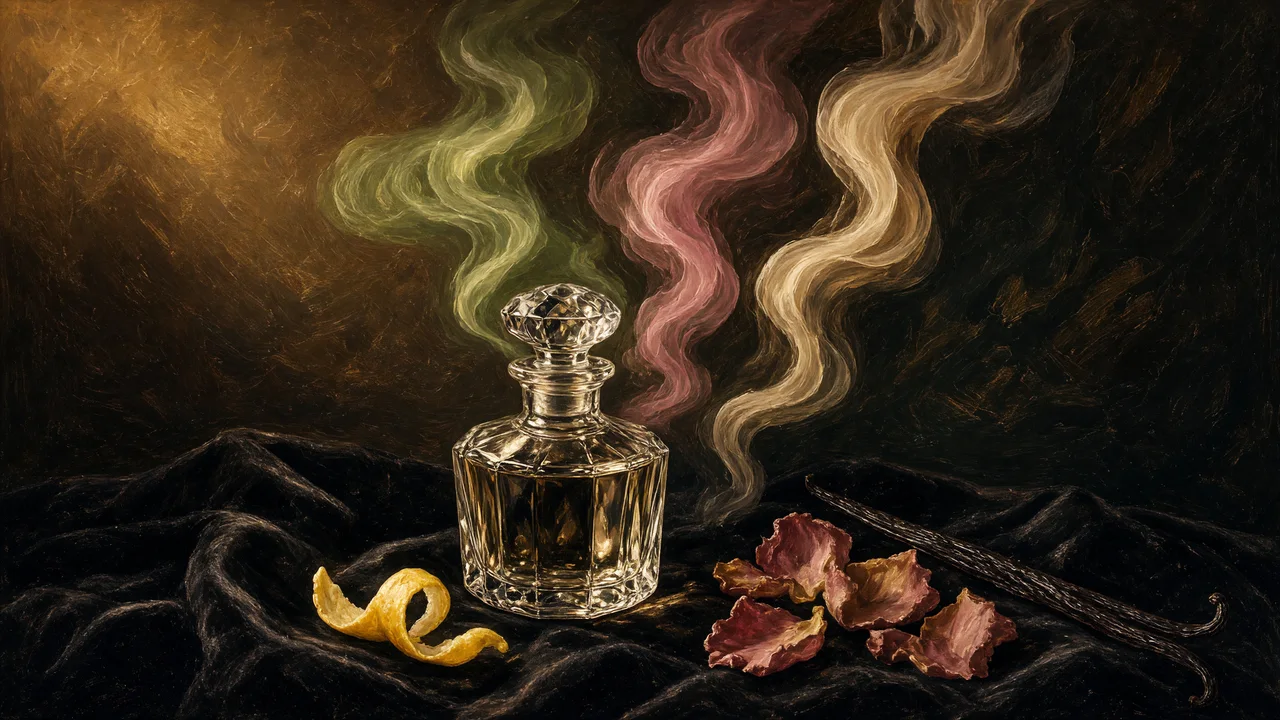
What you smell the moment you spray a perfume is not what you smell three hours later. The reason is that the materials in the formula evaporate at different rates. This rate is called volatility, and it determines the story a perfume tells over time.
Three layers
- Top notes (the opening): The most volatile materials. They form the first impression and usually fade noticeably within the first 15–30 minutes. Citrus, light aromatic herbs and some fresh spices belong to this group.
- Heart (middle) notes: They come forward once the opening settles and carry the scent's character for several hours. Flowers, fruits and many spices sit here.
- Base notes (the dry-down): The slowest-evaporating materials. They stay on the skin for hours, sometimes until the next day. Woods, resins, amber, vanilla and musk are typical base notes.

Examples from each layer
- Bergamot: Top: bright, slightly floral citrus.
- Pink pepper: Top: sparkling, resinous spice.
- Rose: Heart: full, honeyed flower.
- Jasmine: Heart: narcotic, slightly animalic white flower.
- Sandalwood: Base: creamy, milky wood.
- Vanilla: Base: sweet, warm, balsamic.
The pyramid is a model, not a rule
In reality, all the materials in a formula evaporate together from the very first moment; what changes over time is their proportion. The main factors behind volatility are the size of the molecule and its interaction with other materials: in general, smaller and lighter molecules evaporate faster. Some modern perfumes are deliberately designed to be “linear,” meaning they smell much the same from start to finish.
Perfumes to follow as they develop
- Light Blue Dolce&Gabbana: The citrus opening softens noticeably within the first half hour; a good example for observing how long top notes last.
- Shalimar Eau de Parfum: A classic journey from a bergamot opening to a vanillic, balsamic base.
- Molecule 01: A “linear” perfume built on a single synthetic molecule (Iso E Super): the exception to the pyramid.
Key points
- Volatility is the rate at which a material evaporates; it writes the perfume's story over time.
- Top notes work for minutes, heart notes for hours, and base notes for anywhere from hours to days.
- All materials evaporate at the same time; what changes is which one dominates.
- Wait for the dry-down before deciding on a perfume.
Sources
- Robert R. Calkin & J. Stephan Jellinek, Perfumery: Practice and Principles, Wiley, 1994.
- Charles S. Sell (ed.), The Chemistry of Fragrances, Royal Society of Chemistry, 2nd ed., 2006.
- Jean-Claude Ellena, Perfume: The Alchemy of Scent, Arcade, 2011.