What is perfume?
A short history and the basic concepts
Fisfis Academy · 11 min read ·
What you will learn
- Explain what perfume is and what it is made of.
- Trace the historical turning points from incense to modern perfume.
- Use the basic terms correctly: note, accord, formula and fixative.
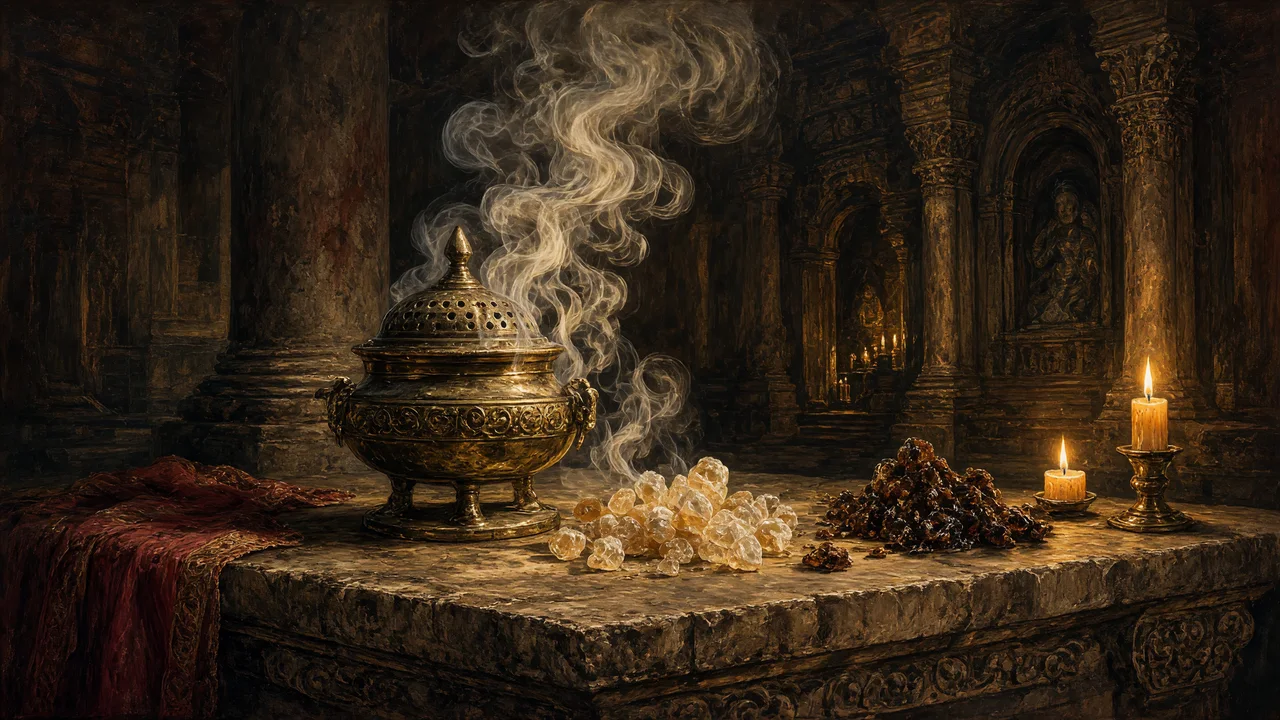
Perfume is a mixture of odorous materials (aromatic compounds) dissolved in a carrier, most often ethyl alcohol. The word is usually traced back to the Latin per fumum, “through smoke”: the first scents were the smoke of resins and plants burned in temples.
The scent palette of antiquity
- Frankincense (olibanum): Lemony, resinous smoke that recalls church incense.
- Myrrh: Bitter, mushroomy, warm resin.
- Labdanum: Dark, ambery resin with a hint of leather.
- Cinnamon: Warm, sweet spice; a staple of ancient ointments.
- Rose: One of the first flowers to be captured in a bottle through distillation.
From smoke to bottle: four turning points
- 3rd millennium BC – Temple smoke: In Egypt and Mesopotamia, resins, spices and scented oils are burned in ceremonies and applied to the body.
- c. 1200 BC – Tapputi: Named on Mesopotamian cuneiform tablets, Tapputi is one of the earliest recorded perfume makers.
- 9th–11th c. – Distillation in the Islamic world: Al-Kindi writes a book on making scents; the development of steam distillation is traditionally credited to Ibn Sina (Avicenna). Rose water spreads around the world.
- 14th c. – Alcohol-based scents: “Hungary Water,” prepared in distilled alcohol, is remembered as one of the first alcohol-based perfumes.
- 1709 – Eau de Cologne: Johann Maria Farina produces his citrus-led cologne in Cologne; a fashion for fresh alcoholic waters is born.
- 1882–1889 – The first synthetic masterpieces: Houbigant's Fougère Royale uses synthetic coumarin, and Guerlain's Jicky makes bold use of coumarin and vanillin.
- 1921 – N°5: Created by Ernest Beaux for Chanel, N°5 puts aldehydes in the foreground and becomes the symbol of modern perfume.
- Antiquity: In Egypt, Mesopotamia and India, resins, spices and plant oils were used in religious ceremonies and in personal care.
- The development of distillation: Steam distillation was developed in the medieval Islamic world, and products such as rose water became widespread. This technique became the basis for extracting essences from plants.
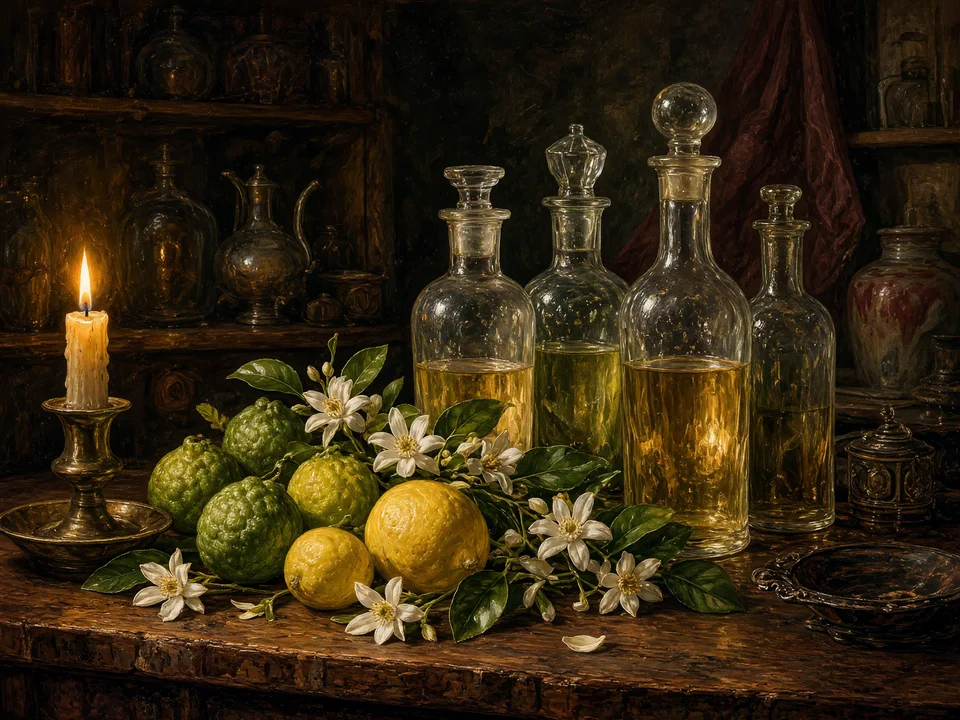
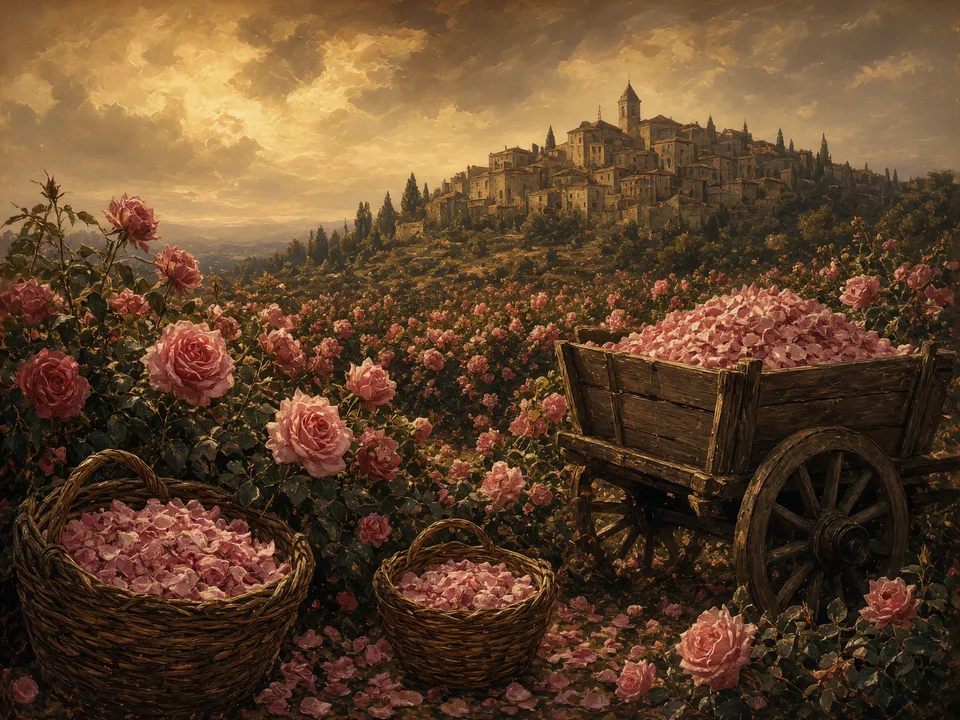
- Cologne and Grasse: In the early 18th century, the citrus-led “Eau de Cologne” became famous in Cologne. Grasse, in the south of France, moved from a tradition of leather tanning to flower growing and perfume production, and became the center of the industry.
- Synthetic molecules: At the end of the 19th century, the laboratory production of molecules such as coumarin and vanillin launched modern perfumery. Fougère Royale (1882) was one of the first major perfumes to use synthetic coumarin; in 1921, Chanel N°5 opened a new era with its bold use of aldehydes.
Three bottles from history
- Jicky: An early masterpiece built with synthetic coumarin and vanillin; listen for lavender meeting a sweet, powdery base.
- N°5 (Vintage): The bright, soapy, fizzy aldehydic opening is the starting line of modern perfume.
- Angel: The perfume that brought the gourmand family into the mainstream in 1992 with caramel, chocolate and patchouli.
Key terms you need to know
- Note
- A single scent impression perceived in a perfume, such as a “bergamot note” or a “vanilla note.” A note can come from one material or from a combination of several.
- Accord
- A group of materials that together create a new, unified scent. Like a chord in music, it produces an effect different from the sum of its parts.
- Formula
- The recipe of a perfume: a list of which materials are used and in what proportions.
- Fixative
- Low-volatility materials that help slow the evaporation of more volatile ones and give a scent longevity (for example, some resins and musk molecules).
- Perfumer (the “nose”)
- A specialist who creates scents. A perfumer knows hundreds of materials by heart and writes formulas.
- Mouillette
- A thin, absorbent paper strip used for testing scents (a smelling strip).
Key points
- Perfume is a mixture of odorous materials, usually dissolved in ethyl alcohol.
- Its history can be read in four big steps: incense and ointments, distillation, alcoholic colognes, synthetic molecules.
- Most modern perfumes use natural and synthetic materials together.
- A note is an impression; an accord is a new scent effect created by several materials together.
Sources
- Edwin T. Morris, Fragrance: The Story of Perfume from Cleopatra to Chanel, Scribner, 1984.
- Jean-Claude Ellena, Perfume: The Alchemy of Scent, Arcade, 2011.
- Luca Turin & Tania Sanchez, Perfumes: The A–Z Guide, Viking, 2008.
- Paul Jellinek, The Practice of Modern Perfumery, Leonard Hill, 1954.