Concentrations
The difference between EDC, EDT, EDP and Parfum
Fisfis Academy · 10 min read ·
What you will learn
- Explain the difference between EDC, EDT, EDP and Extrait using approximate percentages.
- Discuss the limits of the link between concentration and longevity.
- Do a simple dilution calculation.
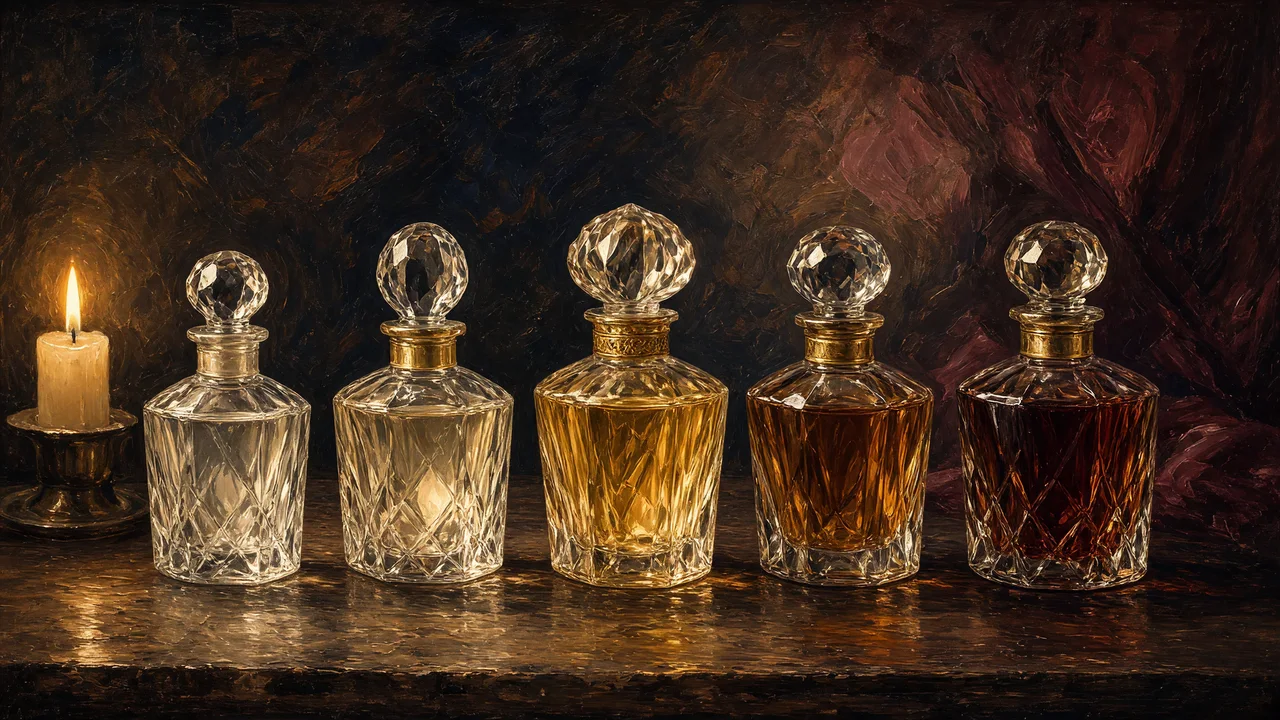
How much of the liquid in a bottle is odorous material (perfume concentrate) determines the name of the product. There is no binding international standard for these percentages; the ranges below are approximate values widely accepted in the industry, and they vary from brand to brand.
- Eau Fraîche / splash: about 1–3%. Very light and refreshing.
- Eau de Cologne (EDC): about 2–5%. Traditionally citrus-led and short-lived.
- Eau de Toilette (EDT): about 5–15%. The most common form for everyday wear.
- Eau de Parfum (EDP): about 15–20%. Fuller and usually longer-lasting.
- Parfum / Extrait: about 20–30% and above. The most concentrated form; usually applied in small amounts.
Eau de Toilette
- About 5–15% concentrate
- Brighter, with a more pronounced opening
- Easy to wear by day, at the office and in hot weather
- Can be refreshed during the day
Eau de Parfum
- About 15–20% concentrate
- Rounder and fuller
- Usually longer-lasting
- A favorite for evenings and cool weather
Extrait
- About 20% and above
- Close to the skin, dense and rich
- A few dabs are enough
- Usually the most expensive form
Higher concentration = longer-lasting?
Not always. The real factor behind longevity is the formula itself: an EDT with heavy base notes can last longer than an EDP built entirely on citrus. EDT and EDP versions with the same name are also often different formulas, not just the same one at a different dilution.
- Think about when you will wear it A lighter form usually suits the office and hot days better; a richer form suits evenings and cold weather.
- Compare two versions of the same perfume Spray the EDT and the EDP on separate wrists; note the opening, 1 hour and 4 hours. Often it is not only the strength that differs but the character too.
- Look to the formula for longevity An EDT with strong base notes (woods, resins, musk) can last longer than a citrus-led EDP.
Key points
- Concentration is the approximate percentage of perfume concentrate in the bottle; there is no binding standard.
- EDT is the most common everyday form; EDP is fuller, and Extrait is the most concentrated.
- The formula is what really determines longevity; an EDT and EDP of the same name are often different formulas.
- Dilution math: desired volume × percentage = amount of concentrate needed.
Sources
- Robert R. Calkin & J. Stephan Jellinek, Perfumery: Practice and Principles, Wiley, 1994.
- Tony Curtis & David G. Williams, Introduction to Perfumery, Micelle Press, 2nd ed., 2001.